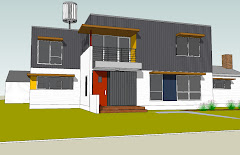
Friday, June 19, 2009

Green Roof and the Sun


Time for an update!
Our green roofs are doing great! The lower roof experienced some freezer burn after the snow came off in March but with the help of a few new cuttings and plugs from Bachmans, it's pulling through and looking better each day. The upper roof looks fantastic! Lots of pretty flowers and colors showing through the green. It's fun to go up on the roof and walk around with the birds and butterflies.


So far this year, our green roofs, rainbarrels and raingardens have captured and used over 60% of the rainfall on the rooftop. The green roofs are responsible for capturing about 45% of the total rainfall. That's looking good!
On the energy side, our solar panels are performing a little better than expected. From January through May - our PV panels have produced 768 kwh of electricity - which is 40% of the house load and/or 30% of the independent office load and just at 25% of the combined whole house and office load. I expect that number to climb higher as we move into full summer sun.
Our hot water panels are in full production and right now through Sept/October, we should get 100% of our hot water needs produced by our solar hot water panels.

Wednesday, April 22, 2009

Energy Use and Usefulness


Hi Gang - thank you for hanging in there with us. We're getting ready for the Mpls/St Paul House Tour this weekend and HGTV to come film next week for the second series of World's Greenest Homes (2) and we're all a flutter. A little cleaning, a little touch up painting and watering the green roof and lawn because we've had no appreciable rain yet this spring and things are drying out. We'll get rain all weekend I'm sure.

SO - We've been busy measuring our energy use and production for the past 6 months - and while it's still a little early to be conclusive, I can say that our home is performing well.
The solar hot water panels seemed to produce nearly 100% of our hot water needs from July - October and the solar PV panels have produced an average of 25% of our whole house electrical energy needs and nearly 50% of the house load if we discount the energy used by all of my office equipment - which is 380 kwh a month - not a typical load in most people's homes!
Given that the balance of the electricity used by the house that we haven't produced ourselves is purchased through Xcel Energy's Windsource program - we're feeling pretty good about our carbon footprint.

A fun little fact - our house uses less energy than the former house does even though it is nearly twice as big. I'll wait to give an exact percentage until we have a full year's worth of data. What I can tell you right now is that our new and improved home uses 47% less electrical energy per square foot and 63% less gas per square foot than the original house did. I expect these numbers to improve as we move through Spring and early Summer - when we'll need very few lights and very little cooling.

I'm also in the process of tying our kilowatt hours of electricity and ccf of gas into an average kBTU/carbon emissions total and square foot for the house. It will be great to be able to see if we use more or less than the amounts predicted by our energy model (HERS score 52, Energy Star Rating 5 stars plus). I hope we'll be below the predicted use. I think we will be. Look for that post in a few months.

The solar panels get the headlines and ooohs and ahhhs, but most of the energy savings are coming from simple, smart design decisions that everyone can do. We've been talking about all of these things in this blog so I'm sure you're familiar with them. Use better insulation with higher R Values and good air sealing, use high performance windows and passive solar strategies; limit the amount of glazing to the west and north, protect the south glazing from solar gain in the summer, maximize it in the winter, use high efficiency energy star rated equipment, use CFL and LED lights, turn your lights off when you leave the room, have heat recovery system on your furnace exhaust, caulk around windows and doors, set your thermostat higher in the summer and lower in the winter....and all the other basic stuff that leads to better energy savings.

Monday, April 20, 2009

Awards and the Minneapolis Saint Paul Home Tour


EcoDEEP HAUS has recently won two design awards - the Home of the Month Design award sponsored by The Minneapolis StarTribune and a RAVE Award, sponsored by AIA Minnesota and Minneapolis St Paul magazine. EcoDEEP HAUS will be featured in each of the publications during the upcoming year. We'll post more when we know more.


Also - the HAUS is part of this years Minneapolis Saint Paul Home Tour this coming weekend- Aril 25th and 26th. Come have a look at the place if you are able! Learn more about the tour here: http://www.msphometour.com/


Rumor has it that HGtv will be filming our digs the following week for the World's Greenest Homes series. We'll let you know more about that too!

Sunday, March 22, 2009

Rain Rain Rain


For the past week or so we have experienced the first signs of Spring (temps in the 50's, grass showing through the snowmelt and college kids wearing t-shirts and shorts outdoors) we are getting our rain barrels cleaned up and ready for action.

We collect rainwater. We use it to water our gardens (tomatoes and basil grow much better with rainwater than treated tap water) and trees, and any excess gets diverted to our raingardens so that stormwater infiltrates back to the aquifer rather than being sent down through the storm sewer system and into the mighty Mississippi River.

You may recall that we also installed a green roof system (see our post in October, 2008 for more info) to help manage stormwater, among other benefits.

So how much difference do our actions really make? Well, we've been measuring, and while we only have a few months of collected data - we can tell you what we know to be true at this point (stay tuned for updates).

Our total rooftop area is 1,724 square feet and will generate approx. 1,077 gallons of stormwater during a 1" rainfall. Left to its own devices, much of that would find its way elsewhere, and eventually to the river. But the data we collected between July and November of last year suggest that our rain barrels collected some 48% (16% used of for irrigation, 32% diverted to raingardens) or a little over 5,400 gals of water. Our green roof absorbed some 12% (1,200 gals) of the total rainfall at the rooftop for that same period even though it was only in place since October. So, during the 5 months we were able to measure, we diverted 60% of the rainfall at our rooftop from moving across our lawn and into the storm sewer system and river. I expect this number to increase significantly when we have a full year's worth of data and a full year's worth of green roof performance.

That means that if everyone utilized a rainbarrel at one or more of their downspouts we would save enormous amounts of stormwater, sediment, chemicals and fertilizers from entering our lakes and rivers; our recreational waters and our drinking water. That's healthier for everyone. It also means less water being treated by our local governmental water treatment facilities, which saves us money and keeps our waterways beautiful and usable.
We'll report more when we know more! Next up, a post on our energy use. There have been a few unexpected twists and turns as we've measured and monitored our consumption.

Monday, November 24, 2008

350.org- what everyone should know!


This past week, we were both attending Greenbuild in Boston. Greenbuild is USGBC's annual conference (United State Green Building Council). This year over 30,000 people attended the convention in a rather chilly Boston. The opening speaker for the event was Archbishop Desmond Tutu. Yep, you could say this conference was no small potatoes.


One great speaker was writer, environmentalist and professor Bill McKibben. Click the link if you want to hear his talk. It was inspiring and urgent message that reminded us just how crucial it is that we act now.

He has created a grass-roots organization called 350.org. http://www.350.org/

Here's the deal: 350 is the red line for human beings, the most important number on the planet. The most recent science tells us that unless we can reduce the amount of carbon dioxide in the atmosphere to 350 parts per million, we will cause huge and irreversible damage to the earth. We are currently at 385 and it's rising about 2 parts per year.


The goal of this organization is to get the word out. We need an international agreement to reduce carbon emissions fast. The United Nations is working on a treaty, which is supposed to be completed in December of 2009 at a conference in Copenhagen, Denmark. But the current plans for the treaty are much too weak to get us back to safety. This treaty needs to put a high enough price on carbon that we stop using so much.

If you have care about what happens to the planet, spread the word!


Tuesday, October 28, 2008

New and Improved Photos!

A few weeks ago, we had Scott Gilbertson, architectural photographer extraordinare www.gilbertsonphotography.com, take some photos of the house. Here are just some of the photos:


Thursday, October 2, 2008

Power Plants on the Roof


Hello one and all - yesterday was a red letter day for the HAUS - we installed our green roof (800 sf in 6hrs!) and it looks amazing! For those of you who'd like to know, we used a vegetated roof system called LiveRoof. It comes in preplanted modular trays (1 ft x 2ft by 4" deep) with native plant species selected for your specific exposure and microclimate.

Our roof used 2 different plant mixtures -
Classic Carefree Sunny Mix
Sedum Album (Coral Carpet)
Sedum hybridium(Immergrunchen)
Sedum reflexum (Blue Spruce)
Sedum rupestre (Angelina)
Sedume sexangulare
Sedum spurium (dragon's blood)
Sedum Neon
Allium Flowering Onion

and
Shade Mix
Sedum Pachylados
Sedum hybridium(Immergrunchen)
Sedum spurium (Fireglow)
Sedum rupestre (Angelina)
Sedume sexangulare
Sedum spurium (Green Mantle)
Sedum Spurium (Royal Pink)

These plants are carefully selected to handle lots of rain but also do well for long periods without rain in our Minnesota climate. They will grow to be between 2 and 4 inches tall -and besides periodic weeding will require very little maintenance.

I like the Live Roof system because it comes fully planted and ready to rock and roll. We ordered the plants in early June and the nursery did most of our work for us - growing and caring for the plants all summer long before harvesting them for us this past week and prepping them for our installation. Now that they are on our roof, we don't need to be watching bare dirt with a few plant plugs watching and waiting for them to grow - it's an instant green!


Boy, You Crazy! Why you want a green roof?
Green Roofs help:
  • Manage stormwater (up to 95% of rain fall is used by the green roof)
  • Reduce Energy Costs (energy use reduction of 25% and higher)
  • Extend the life of the primary roof system by 200% (protecting rooftop from temperature swings, ultraviolet radiation, etc)
  • Noise Reduction
  • Improve air quality
The Live Roof system costs about $12.00 per sf but will vary depending on the size of your order. We installed it ourselves and so saved a lot on labor costs. We worked out the details and became certified green roof installers through our local Live Roof supplier - Bachman's nursery.

Here are some photos of the installation in progress:

The plants arrived via truck and after unloading are ready to be brought up to the rooftop.


We rented a scissors lift to help move the modules (about 50 lbs each) up to the rooftop. There was no way I was going to carry 400+ roof modules one at a time on a ladder. The plywood on the ground helps protect the newly planted lawn.


Even local celebrities get in on the act. Here, the famous Curt Kietzer carries the first of many modules to it's final destination. My brother Brian is working the lift.


Getting Started - all the modules click together to stabilize each other and promote better plant growth. The green soil elevators keep the soil in place until they are installed. Working from right to left, we filled in the rooftop pretty quickly. You can see the dark grey 45 mil epdm slip sheet we used as root barrier on top of our real roof membrane. We don't want the plants messing with our roof membrane!


Jeffrey Swainhart is the man with the saw cutting the modules at the end of each row to ensure a tight fit. Cutting takes a long time and should be minimized!


Regular sweeping is critical to avoid pinching any sharp aggregates between the plant trays and the roof membrane.


Curt K and Guy Williams seen splicing the joints at the metal edging - I favor the edging over the cutting .


When the upper roof was nearly complete, we started in on the lower roof (Shade Mix)


Lower roof complete


Upper roof complete


A nice detail so my ladder doesn't damage the plantings on the lower roof when I need to access the upper roof. The pavers are recycled rubber porous paver systems called VAST from our friends at Natural Built Home.

We've been measuring how much water our rooftop generates during each rainfall (we're collecting runoff in rain barrels). Now, with the green roof in place we can track the reduction in that amount. Rather than sending our runoff to the stormsewer system and thus to the Gulf of Mexico via the Mississippi River, we're using the rainwater to keep our plants healthy and happy so they can do all those good things for our home.